Beginner’s Guide to SEO for Indian Businesses
A complete beginner’s guide to SEO tailored for Indian businesses. Learn how search engines work, keyword research, on-page and off-page strategies, local SEO, and future trends to grow your digital presence and rank higher on Google.
P&P CONNEKTS
3/8/20262 min read
Search Engine Optimization (SEO) is the backbone of digital visibility. In India, where over 800 million people are online and competition is fierce across industries, SEO is no longer optional—it’s essential. Whether you run a local shop in Vijayawada, a startup in Bengaluru, or an e-commerce brand in Delhi, SEO ensures that your customers find you when they search on Google.
Unlike paid ads, SEO builds long-term organic traffic. It’s cost-effective, scalable, and helps businesses establish credibility. This guide will walk you through everything you need to know about SEO, step by step, with examples relevant to Indian businesses.
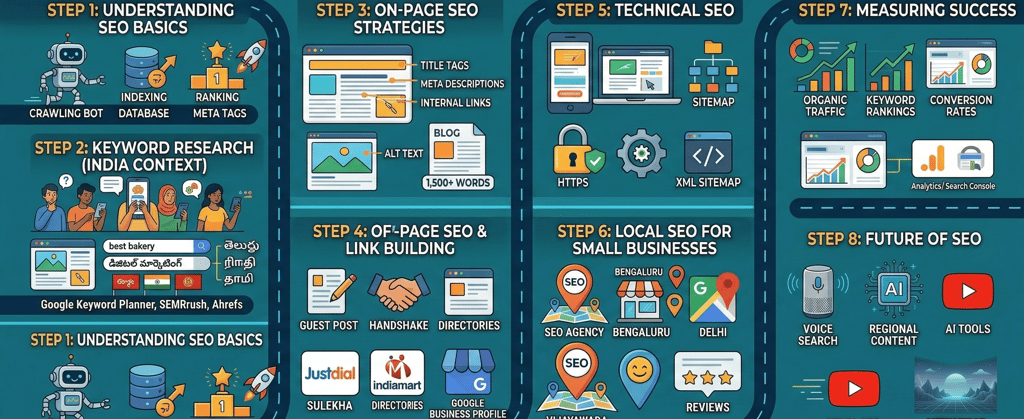
Chapter 1: Understanding SEO Basics
SEO is about helping search engines understand your website and rank it higher for relevant searches.
How Search Engines Work
Crawling: Google bots scan websites for content.
Indexing: Pages are stored in Google’s database.
Ranking: Algorithms decide which page appears first.
Types of SEO
On-Page SEO: Optimizing content, titles, meta descriptions.
Off-Page SEO: Building backlinks and authority outside your site.
Technical SEO: Ensuring your site is fast, mobile-friendly, and easy to crawl.
Key SEO Terms
Keywords: Search phrases people use.
Backlinks: Links from other websites pointing to yours.
Meta Tags: HTML snippets that describe your page.
Domain Authority: A score that predicts how well a site will rank.
Chapter 2: Keyword Research for Indian Businesses
Keywords are the foundation of SEO.
Why Keywords Matter
If you own a bakery in Hyderabad, ranking for “best bakery in Hyderabad” will bring local customers directly to your shop.
Tools for Keyword Research
Google Keyword Planner
SEMrush
Ahrefs
Ubersuggest
Types of Keywords
Short-tail keywords: “Digital marketing” (high competition).
Long-tail keywords: “Affordable digital marketing agency in Hyderabad” (lower competition, higher conversion).
Local keywords: “SEO services in Vijayawada.”
Regional language keywords: “డిజిటల్ మార్కెటింగ్ ఏజెన్సీ హైదరాబాద్” (Telugu).
Chapter 3: On-Page SEO Strategies
On-page SEO ensures your website content is optimized for both users and search engines.
Key Elements
Title Tags: Include keywords naturally.
Meta Descriptions: Summarize the page in 160 characters.
Headings (H1, H2, H3): Organize content clearly.
Image Optimization: Use alt text and compress images.
Internal Linking: Guide readers to related pages.
Content Length: Aim for 1,500+ words per blog.
Chapter 4: Off-Page SEO & Link Building
Off-page SEO builds your website’s authority.
Strategies
Guest blogging on Indian business websites.
Listing your business in directories like Justdial, Sulekha, IndiaMart.
Social bookmarking on sites like Reddit, Pinterest.
Encouraging customer reviews on Google Business Profile.
Case Study
A real estate agency in Mumbai improved rankings by publishing guest blogs on housing portals and earning backlinks from news sites.
Chapter 5: Technical SEO
Technical SEO ensures your site is easy to crawl and loads quickly.
Checklist
Improve website speed with caching and compression.
Ensure mobile-first design.
Use HTTPS for security.
Submit XML sitemaps to Google Search Console.
Add schema markup for rich snippets.
Chapter 6: Local SEO for Indian Businesses
Local SEO is crucial for small businesses.
Steps
Claim and optimize your Google Business Profile.
Add your business to local directories.
Use geo-targeted keywords like “SEO agency near me.”
Collect customer reviews to boost trust.
Chapter 7: Measuring SEO Success
Tracking performance ensures your SEO efforts are paying off.
Tools
Google Analytics: Track traffic, bounce rate, conversions.
Google Search Console: Monitor indexing and keyword rankings.
SEO Tools: SEMrush, Ahrefs, Moz.
Metrics
Organic traffic growth
Keyword rankings
Conversion rates
Domain authority
Chapter 8: Future of SEO in India
SEO is evolving rapidly.
Trends
Voice Search: Optimize for queries like “best digital marketing agency near me.”
Regional Language SEO: Hindi, Telugu, Tamil, Bengali.
AI-Powered SEO Tools: Automating keyword research and content optimization.
Video SEO: YouTube and Instagram Reels.
Metaverse Marketing: Immersive experiences for brands.
Conclusion
SEO is a long-term investment for Indian businesses. By focusing on keywords, content, technical improvements, and local visibility, you can build a strong online presence and consistently attract customers. Start small, stay consistent, and watch your rankings grow.
P&P CONNEKTS

We Bridging the gap between brands and growth. Specialized in authentic content and high-impact digital strategies.
+91 9912328277 +91 9247536131
© 2025. All rights reserved.
P&P CONNEKTS
Services
Social Media Management
Brand Identity & Design
Influencer Marketing
Performance Marketing
Strategic Consulting